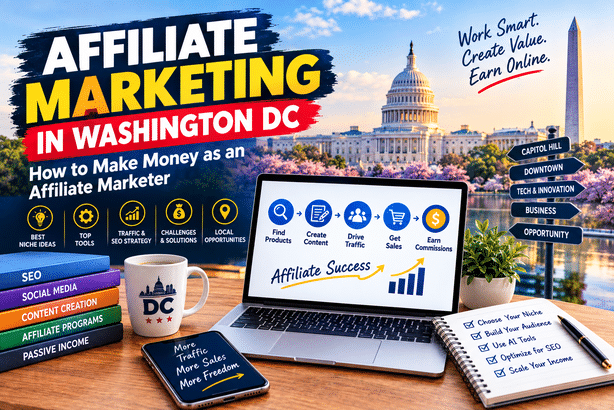
Affiliate marketing in Washington DC is becoming an increasingly attractive way for creators, bloggers, freelancers, professionals, and online entrepreneurs to build an additional income stream without creating their own products.
If you live and work in Washington, DC, you have access to a unique combination of local businesses, professionals, technology companies, government-related industries, tourism, education, finance, real estate, healthcare, hospitality, and a large population of consumers searching online for products and services.
That creates opportunities for anyone willing to build an audience and connect that audience with useful products or services through affiliate marketing.
But there is an important distinction between simply placing affiliate links on a website and building a profitable affiliate business.
Successful affiliate marketers in Washington DC need a niche, a content strategy, search visibility, trust, traffic, conversion optimization, and an understanding of the business and advertising requirements that apply to their activities.
This guide explains how affiliate marketing works in Washington DC, the major challenges you may face, the best niches to consider, how to find affiliate programs, how to use SEO and social media to generate traffic, and how to turn affiliate marketing into a sustainable online business.
What Is Affiliate Marketing?
Affiliate marketing is a performance-based marketing model where you promote another company’s products or services and receive a commission when someone completes a qualifying action through your referral.
Depending on the affiliate program, that action could be:
- Purchasing a product
- Signing up for a software subscription
- Opening an account
- Requesting a quote
- Booking accommodation
- Registering for a service
- Completing an application
- Starting a free trial
For example, imagine you operate a website focused on Washington DC lifestyle and technology.
You could publish an article such as:
“10 Best Productivity Tools for Washington DC Professionals”
Inside the article, you could recommend relevant software products using affiliate links.
If a reader clicks your affiliate link and completes a qualifying purchase or subscription, the merchant or affiliate network may pay you a commission.
The basic model is:
Traffic → Content → Affiliate Click → Conversion → Commission
The challenge is building enough targeted traffic and trust to make the process repeatable.
Why Affiliate Marketing in Washington DC Can Be Attractive
Washington, DC is not simply a political center. It is also a major business, technology, education, tourism, professional-services, and cultural market.
That creates many potential content niches for affiliate marketing in Washington DC.
A marketer could target audiences interested in:
- Technology
- Software
- Career development
- Remote work
- Personal finance
- Travel
- Hotels
- Restaurants
- Fitness
- Education
- Professional development
- Productivity
- Home office equipment
- Small-business tools
- Digital marketing
- Entrepreneurship
- Photography
- Events
- Lifestyle products
You don’t necessarily need to promote products exclusively to people physically located in Washington, DC.
A DC-based affiliate website can target people searching for information about Washington DC, while also building national or international traffic.
That distinction is extremely important.
Your location can provide your content with a local perspective, but your potential audience can extend far beyond the District.
How to Make Money With Affiliate Marketing in Washington DC
There is no single method that guarantees affiliate income.
Instead, profitable affiliate marketing in Washington DC generally involves combining several traffic and conversion channels.
1. Build a Washington DC Affiliate Website
One of the strongest long-term approaches is creating a niche website.
Instead of publishing random affiliate links, build a website around a specific audience.
For example:
DC Technology Website
Possible content:
- Best laptops for DC professionals
- Best productivity software for remote workers
- Best project management tools
- Best website builders for small businesses
- Best AI tools for entrepreneurs
- Best home-office equipment
Another possibility is a:
Washington DC Travel Website
Possible content:
- Best hotels in Washington DC
- Things to do in Washington DC
- Washington DC travel essentials
- Best travel accessories
- Best booking platforms
- Washington DC weekend itinerary
- Best tours and experiences
The key is to build topical authority rather than publishing unrelated articles simply because an affiliate program exists.
2. Choose a Profitable Affiliate Niche
Choosing your niche is one of the most important decisions you will make.
A good affiliate marketing niche in Washington DC should ideally have:
- Commercial demand
- Search volume
- Products or services people already purchase
- Available affiliate programs
- Reasonable commission potential
- Content opportunities
- An audience you understand
Consider these potential niches.
Technology and Software
Technology can be particularly useful for affiliate marketers because many software companies offer recurring commissions or relatively high customer values.
Potential topics include:
- AI tools
- SEO software
- Website builders
- Hosting
- VPNs
- Productivity software
- Email marketing
- CRM platforms
- Accounting software
- Project management tools
For example:
“Best SEO Tools for Washington DC Small Businesses”
could target both local business owners and marketers.
3. Explore Personal Finance Affiliate Marketing
Finance is another potentially valuable niche, although it requires considerably more care.
Content could include topics such as:
- Budgeting tools
- Credit-monitoring products
- Financial education platforms
- Investing resources
- Tax software
- Banking-related services
- Business finance software
However, financial content requires a high level of accuracy and responsibility.
Avoid making unsupported claims about financial products or promising specific financial outcomes.
Your objective should be to provide useful information that helps readers understand their options.
4. Use Travel Affiliate Marketing
Washington DC attracts tourists, business travelers, students, families, conference attendees, and international visitors.
This creates opportunities for travel affiliate marketing in Washington DC.
Potential content includes:
“Best Hotels for a Weekend Trip to Washington DC”
“Washington DC Travel Guide for First-Time Visitors”
“Best Travel Accessories for Your Washington DC Trip”
“Where to Stay in Washington DC: Neighborhood Guide”
You could potentially monetize relevant content through hotel, travel, transportation, tour, luggage, insurance, and travel-product affiliate programs.
The most important principle is matching the product to the reader’s intent.
Someone searching for:
“best hotel near Washington DC attractions”
has substantially stronger commercial intent than someone searching for:
“Washington DC history.”
5. Target Remote Work and Home Office Products
Washington DC has a large professional workforce, and remote and hybrid work create opportunities for content around productivity.
You could create content around:
- Laptops
- Monitors
- Webcams
- Microphones
- Headsets
- Office chairs
- Desks
- Lighting
- Productivity software
- Cloud storage
- Communication tools
For example:
“Best Home Office Setup for Washington DC Remote Workers”
could combine product reviews, comparisons, buying guides, and affiliate links.
This type of content works especially well when you provide genuine comparisons instead of simply listing products.
6. Target Washington DC Small Businesses
Another powerful opportunity is creating content for local entrepreneurs.
Consider keywords such as:
Washington DC small business tools
best website builder for DC businesses
best accounting software for small businesses
best CRM for small business
best SEO tools for local businesses
best email marketing software
best AI tools for small business
This approach allows you to target business owners who already have commercial intent.
Instead of promoting products randomly, create content around problems.
For example:
“How to Choose the Right CRM for a Washington DC Consulting Business”
Then compare several relevant solutions.
7. Build a Local SEO Affiliate Strategy
Local SEO for affiliate marketing can help you capture searches connected to a specific geographic market.
Create content around combinations of:
product + Washington DC
service + Washington DC
best + category + Washington DC
Washington DC + buyer guide
Washington DC + comparison
Washington DC + recommendations
However, don’t create hundreds of nearly identical pages just by replacing the city name.
The content needs genuine local value.
Add:
- Local observations
- Neighborhood information
- Local pricing where appropriate
- Transportation considerations
- Local audience needs
- Original photographs
- Personal experience
- Local comparisons
- Useful maps or directions where relevant
That makes the page more useful than a generic article with “Washington DC” inserted into every paragraph.
The Biggest Challenges of Affiliate Marketing in Washington DC
Although the business model can be attractive, affiliate marketing in Washington DC has several challenges.
Understanding them before starting can save you significant time.
Challenge 1: Competition
The internet is extremely competitive.
You are not only competing with other DC affiliate marketers.
You may also compete against:
- Major publishers
- Review websites
- Newspapers
- National blogs
- E-commerce companies
- Influencers
- YouTube creators
- Reddit discussions
- Established affiliate websites
Ranking for a broad keyword such as:
“best laptops”
can be extremely difficult.
Instead, build authority around narrower topics.
For example:
“Best laptops for Washington DC remote workers”
or:
“Best laptops for small business owners in Washington DC.”
Specific search intent gives you a clearer audience.
Challenge 2: Getting Website Traffic
Having affiliate links does not automatically produce sales.
You need visitors.
There are several traffic channels available to an affiliate marketer in Washington DC:
Google Search
Create SEO content targeting informational and commercial keywords.
YouTube
Create product reviews, tutorials, comparisons, and demonstrations.
TikTok
Create short-form videos around products, problems, comparisons, and recommendations.
Use Reels, carousels, Stories, and educational content.
Pinterest can be useful for visual niches such as travel, lifestyle, home office, fashion, food, and personal organization.
Email Marketing
Build an email list and provide useful content before promoting relevant offers.
The strongest strategy is usually not depending entirely on one traffic source.
Challenge 3: Building Trust
People are increasingly skeptical of affiliate websites.
If every article says:
“This is the best product!”
readers may stop believing you.
Instead, explain:
- Who the product is for
- Who should avoid it
- What it does well
- Its limitations
- How it compares with alternatives
- What type of buyer should consider it
- What factors should influence the buying decision
This approach makes your content more useful and can improve conversions.
Challenge 4: Affiliate Disclosure Requirements
Affiliate marketers must take advertising disclosures seriously.
The Federal Trade Commission says affiliate relationships should be disclosed clearly and conspicuously so consumers understand that the publisher may receive compensation. The FTC specifically gives affiliate marketers examples such as stating that commissions are earned from purchases made through links.
A disclosure should not be hidden on a separate legal page where readers are unlikely to see it.
For example, you could use language such as:
Disclosure: This article contains affiliate links. If you purchase through some of the links, we may earn a commission at no additional cost to you.
The exact wording can vary, but it should communicate the relationship clearly.
The FTC also advises that disclosures should be close to the endorsement or recommendation rather than buried somewhere difficult to notice.
Challenge 5: Washington DC Business Requirements
If you are actually operating a business from Washington, DC, don’t assume that being an online business means there are no local administrative requirements.
The District’s Department of Licensing and Consumer Protection lists marketing and related activities among its general business categories and identifies requirements that can include business registration, tax registration, and a Certificate of Occupancy or Home Occupation Permit depending on the circumstances.
If you operate a qualifying business from your DC residence, the District says a Home Occupation Permit is required before obtaining the business license.
Requirements can depend on how your business is structured and operated, so check current District requirements before launching a formal business from your home.
Challenge 6: Taxes
Affiliate commissions are income.
The IRS states that self-employed individuals generally have federal tax obligations related to self-employment income and notes that net self-employment earnings of $400 or more can trigger a federal filing requirement even when the activity is a side job.
Washington DC residents can also have District income-tax obligations. The District’s Office of Tax and Revenue states that DC residents who meet its filing criteria must file a District income tax return.
For a growing affiliate business, maintain accurate records of:
- Affiliate commissions
- Business expenses
- Software subscriptions
- Hosting
- Domain registration
- Advertising
- Content production
- Equipment
- Professional services
- Education and training
For personalized tax advice, consult a qualified tax professional familiar with your circumstances.
How to Find Affiliate Programs
Once you select your niche, look for companies that offer affiliate partnerships.
You can search:
“[product category] affiliate program”
For example:
AI software affiliate programs
SEO software affiliate programs
Washington DC travel affiliate programs
hotel affiliate programs
website hosting affiliate programs
business software affiliate programs
You can also investigate affiliate networks that connect publishers with multiple advertisers.
Before joining a program, examine:
- Commission rate
- Cookie duration
- Payment terms
- Minimum payout
- Geographic restrictions
- Product quality
- Refund policy
- Promotional restrictions
- Trademark rules
- Search advertising restrictions
Do not choose an affiliate program solely because the commission percentage looks high.
A low-converting product with a high commission can produce less income than a trusted product with strong demand.
Create Content That Converts
One of the biggest mistakes new affiliate marketers make is publishing articles without considering buyer intent.
Not every keyword is equally valuable.
Compare:
“What is a VPN?”
with:
“Best VPN for remote workers.”
The second keyword has stronger commercial intent.
Other high-intent formats include:
Best-of Articles
Best AI Tools for Small Businesses
Comparison Articles
Product A vs Product B
Review Articles
Product A Review: Features, Pricing and Alternatives
Alternatives Articles
Best Alternatives to Product A
Buying Guides
How to Choose the Best CRM for a Small Business
Problem-Solution Articles
How to Manage Multiple Clients Without Losing Track of Projects
These formats can naturally introduce affiliate products.
Use SEO to Grow Your Affiliate Business
Affiliate SEO should be one of your most important long-term strategies.
Start by researching keywords.
Look for:
- Search intent
- Search volume
- Competition
- Commercial intent
- Related questions
- Long-tail keywords
- Competitor content gaps
Then build topic clusters.
For example, suppose your niche is AI tools.
Your main page could be:
Best AI Tools for Small Businesses
Supporting articles could include:
- Best AI writing tools
- Best AI SEO tools
- Best AI meeting assistants
- Best AI customer-service tools
- Best AI productivity tools
- Best AI image generators
- AI tools for entrepreneurs
- AI tools for remote workers
These articles can internally link to one another.
That helps create a more organized topical structure.
Don’t Build a Website Filled With Generic AI Content
AI can help affiliate marketers research, brainstorm, outline, summarize, and repurpose information.
But AI should not become a shortcut for producing hundreds of generic pages.
Your content should add value.
Include:
- Original analysis
- First-hand experience where applicable
- Product screenshots
- Demonstrations
- Original comparisons
- Testing
- Pros and cons
- Practical recommendations
- Unique examples
- Expert commentary
- Updated information
The goal is not to produce the largest number of articles.
The goal is to produce content that deserves to be read, referenced, shared, and ranked.
Use TikTok for Affiliate Marketing in Washington DC
TikTok affiliate marketing can be particularly useful for demonstrating products.
Instead of creating a video that simply says:
“Buy this product.”
Create a useful demonstration.
A simple structure is:
0–2 Seconds: Hook
“Three tools every DC remote worker should know about.”
2–7 Seconds: Problem
“Working from home but struggling to organize multiple projects?”
7–20 Seconds: Demonstration
Show the product or software solving the problem.
Final Seconds: CTA
“Check the link to learn more.”
Always ensure required disclosures are visible and understandable.
The FTC says social media influencers should make material connections obvious and place disclosures where followers can easily see and understand them.
Use YouTube for High-Intent Affiliate Traffic
YouTube is another powerful channel.
Create videos such as:
Best AI Tools for Small Businesses
Top 5 Website Builders Compared
Best Home Office Equipment
SEO Tools I Use for Client Websites
Best Travel Accessories for Washington DC
Product A vs Product B
You can place relevant affiliate links in the video description while explaining the affiliate relationship clearly.
YouTube also gives you the opportunity to demonstrate products instead of simply describing them.
Demonstration can increase trust.
Build an Email List
Don’t depend entirely on Google or social media.
Build an email audience.
For example, offer a free resource:
“The Washington DC Digital Entrepreneur’s Toolkit”
The resource could contain:
- Productivity tools
- Website tools
- AI tools
- Marketing tools
- Finance resources
- Business resources
After someone subscribes, you can send useful educational content.
The goal should be to build a relationship rather than continuously sending promotional links.
Create a Washington DC Affiliate Content Funnel
A simple funnel could look like this:
Google Search
↓
Helpful Blog Article
↓
Email Signup
↓
Product Comparison
↓
Affiliate Recommendation
↓
Merchant Website
↓
Commission
For example:
A person searches:
“best accounting software for small business DC”
They find your article.
The article explains the different options.
They download your free small-business toolkit.
You continue educating them through email.
Eventually, they click your affiliate recommendation and purchase.
That is a much stronger business model than simply placing random affiliate links across your website.
How Much Money Can an Affiliate Marketer in Washington DC Make?
There is no fixed income level for affiliate marketing in Washington DC.
Your income depends on variables such as:
- Traffic
- Audience quality
- Affiliate click-through rate
- Conversion rate
- Commission value
- Product demand
- Content quality
- Search rankings
- Social reach
- Email subscribers
- Customer lifetime value
A useful way to understand the business is:
Affiliate Revenue = Targeted Traffic × Affiliate CTR × Conversion Rate × Commission
For example, if 10,000 targeted visitors reach your content, 5% click an affiliate link, and 4% of those referred visitors convert, you would have:
10,000 × 5% = 500 affiliate clicks
500 × 4% = 20 conversions
If the average commission were $40:
20 × $40 = $800
This is only an illustration, not a guarantee of earnings.
Improving any part of the equation can increase revenue.
Focus on High-Value Affiliate Products
If your goal is to build meaningful income, don’t focus exclusively on cheap products.
Explore products and services where one conversion can generate meaningful revenue.
Examples can include:
- Business software
- SaaS subscriptions
- Hosting
- Marketing platforms
- Professional education
- Business services
- Financial products where permitted and appropriate
- High-value technology
- Travel bookings
- Professional tools
This is one reason high-ticket affiliate marketing can be attractive.
However, high commission alone doesn’t make an offer good.
The product still needs to solve a real problem.
Create Comparison Content
Comparison articles can be excellent for affiliate conversion.
Examples:
Best Website Builders for Washington DC Small Businesses
Shopify vs WooCommerce for DC Entrepreneurs
Canva vs Adobe Express for Content Creators
Best AI Writing Tools for Professionals
Best Email Marketing Platforms for Small Businesses
A good comparison should explain:
- Pricing
- Features
- Ease of use
- Advantages
- Limitations
- Ideal user
- Alternatives
- Important differences
Don’t declare a product “the best” simply because it pays the highest commission.
Your recommendations should be based on the reader’s needs.
Localize Your Affiliate Content
One major advantage of being a Washington DC affiliate marketer is your ability to create locally relevant content.
Instead of:
“Best coworking spaces”
you could target:
“Best Coworking Options for Freelancers in Washington DC”
Instead of:
“Best travel apps”
create:
“Best Travel Apps for Exploring Washington DC”
Instead of:
“Best business software”
create:
“Best Business Software for Washington DC Entrepreneurs”
Local context can make generic affiliate content more useful.
Use Local Experience as Your Competitive Advantage
One of the strongest advantages a DC-based affiliate marketer can develop is first-hand knowledge.
If you actually live in the area, you can potentially create content based on:
- Local neighborhoods
- Transportation
- Business districts
- Events
- Tourism
- Work culture
- Local consumer behavior
- Home-office challenges
- Local entrepreneurship
- Lifestyle considerations
This can make your content more authentic than generic articles produced by publishers with no local connection.
Common Affiliate Marketing Mistakes to Avoid
Mistake 1: Promoting Everything
Don’t join 50 affiliate programs and place links everywhere.
Build around a niche.
Mistake 2: Choosing Commission Over Relevance
A 50% commission is useless if nobody wants the product.
Mistake 3: Publishing Thin Content
A 500-word article with three affiliate links usually doesn’t provide enough value for competitive search queries.
Mistake 4: Ignoring SEO
Great content still needs discoverability.
Mistake 5: Hiding Affiliate Disclosures
Disclose affiliate relationships clearly.
The FTC specifically warns that simply using vague terms such as “affiliate link” may not adequately communicate the financial relationship to consumers.
Mistake 6: Making Unsupported Claims
Don’t promise:
“This product will make you $10,000 every month.”
Instead, explain what the product does and provide evidence where appropriate.
Mistake 7: Depending on One Platform
Google rankings can change.
Social algorithms can change.
Build multiple traffic channels.
A 90-Day Affiliate Marketing Plan for Washington DC
If you’re starting from zero, don’t try to build everything at once.
Days 1–30: Foundation
Choose one niche.
Create your website.
Set up:
- Domain
- Hosting
- WordPress
- Analytics
- Search Console
- Email marketing
- Social profiles
Research at least 30–50 relevant keywords.
Publish your first high-quality articles.
Days 31–60: Content Expansion
Create:
- Product reviews
- Comparison articles
- Buying guides
- Tutorials
- Commercial-intent articles
Start publishing short-form videos.
Repurpose your blog content into:
- TikTok videos
- Instagram Reels
- YouTube Shorts
- Pinterest content
- LinkedIn posts
Build internal links between related articles.
Days 61–90: Optimization
Study your traffic.
Identify:
- Most visited pages
- Highest CTR pages
- Most clicked affiliate links
- Highest-converting offers
- Best-performing keywords
- Best-performing videos
Then improve the pages already showing potential.
Update headlines.
Improve CTAs.
Add comparison tables.
Add demonstrations.
Improve affiliate placement.
Strengthen internal linking.
Build additional supporting content.
A Practical Washington DC Affiliate Marketing Strategy
If I were building a new affiliate marketing website targeting Washington DC, I would avoid trying to compete with massive websites immediately.
Instead, I would build around a tightly defined audience.
For example:
Niche
Digital tools for Washington DC entrepreneurs
Core Topics
- AI tools
- Website tools
- SEO
- Email marketing
- Productivity
- Accounting
- CRM
- Remote work
Content Structure
Pillar Article
“Best Digital Tools for Washington DC Small Businesses”
Supporting articles:
- Best AI tools for DC entrepreneurs
- Best website builders
- Best SEO tools
- Best CRM software
- Best email marketing platforms
- Best accounting software
- Best productivity apps
- Best remote-work tools
Then connect all of these articles through internal links.
This creates a focused topical ecosystem.
Can You Do Affiliate Marketing From Home in Washington DC?
Yes, affiliate marketing can be operated as an online business, but operating from home does not automatically eliminate local business requirements.
The District specifically states that a Home Occupation Permit applies to a business, profession, or other economic activity conducted from a person’s primary residence in DC, and that the permit is obtained before the business license.
The exact requirements depend on your business circumstances.
If you’re turning affiliate marketing into a formal business, review current DC licensing and tax requirements rather than assuming that an online business is exempt.
The Future of Affiliate Marketing in Washington DC
Affiliate marketing is changing.
Consumers increasingly use:
- YouTube
- TikTok
- AI assistants
- Social search
- Online communities
to research products.
That means the future affiliate marketer needs to think beyond traditional blog posts.
The winning approach is increasingly about becoming a trusted information source.
Create:
Articles + Videos + Reviews + Comparisons + Email + Social Content
Instead of:
Affiliate Links + Random Articles
The difference is significant.
Final Thoughts: Building a Sustainable Affiliate Business in Washington DC
Affiliate marketing in Washington DC can be built from a bedroom, home office, coworking space, or professional studio.
You don’t need to manufacture products.
You don’t need to maintain inventory.
You don’t necessarily need employees.
But you do need to create value.
Choose a specific audience.
Find problems that audience has.
Research products and services that genuinely solve those problems.
Create useful content.
Build search visibility.
Use social media.
Build an email list.
Track your affiliate clicks and conversions.
Improve what works.
And most importantly, build trust.
The goal shouldn’t simply be to become another person putting affiliate links on the internet.
The goal should be to become a trusted source of recommendations for a specific audience.
Whether your audience consists of Washington DC professionals, entrepreneurs, travelers, students, remote workers, technology users, small-business owners, or consumers, the underlying principle remains the same:
Help people make better decisions, and build your affiliate business around the value you provide.
For anyone willing to approach the business strategically, affiliate marketing in Washington DC can become more than a side hustle. It can become a structured digital business built around content, search traffic, audience trust, and measurable performance.
Frequently Asked Questions About Affiliate Marketing in Washington DC
Is affiliate marketing legal in Washington DC?
Affiliate marketing is a legitimate online marketing model. However, affiliate marketers must comply with applicable advertising, disclosure, tax, and business requirements. The FTC requires material connections in endorsements to be disclosed clearly and conspicuously.
Can I do affiliate marketing from my apartment in Washington DC?
Potentially, but you should check DC’s home-business requirements. The District states that a qualifying business conducted from a primary residence requires a Home Occupation Permit before obtaining the business license.
How much does it cost to start affiliate marketing in Washington DC?
You can start relatively inexpensively with a domain, hosting, website, content creation, and potentially SEO or marketing tools. Your actual costs depend on whether you produce content yourself or outsource it.
What is the best niche for affiliate marketing in Washington DC?
There isn’t one universally best niche. Potential opportunities include technology, software, travel, productivity, home office equipment, business tools, education, lifestyle, and other categories with strong consumer demand and suitable affiliate programs.
Do I need a website for affiliate marketing?
No. You can use YouTube, TikTok, Instagram, email, or other platforms. However, owning a website gives you more control over your content, SEO strategy, audience experience, and long-term traffic.
How long does affiliate marketing take to make money?
There is no guaranteed timeframe. Search-based affiliate websites often require months of consistent content creation, optimization, and authority building before meaningful organic traffic develops.
Can I combine a job with affiliate marketing?
Yes. Affiliate marketing can be developed as a side business. The key is creating a manageable publishing schedule and consistently improving your content and traffic sources.
How do I start affiliate marketing in Washington DC?
Start by selecting a niche, researching affiliate programs, creating a website or content platform, researching keywords, publishing valuable content, building an audience, adding relevant affiliate offers, and tracking your results.
Your first objective should not be making thousands of dollars immediately. Your first objective should be building a system capable of generating targeted traffic, affiliate clicks, conversions, and repeatable revenue.